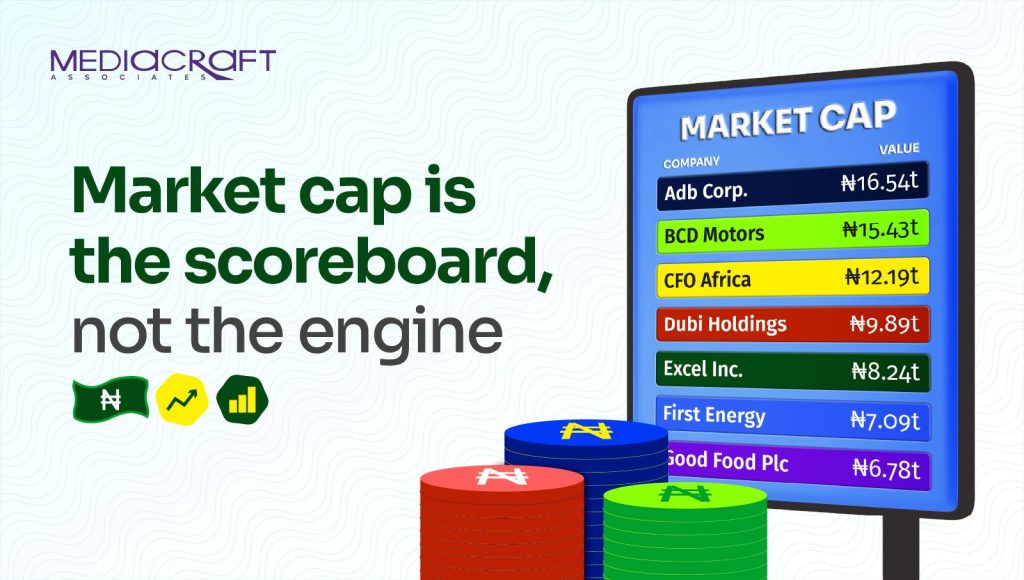
Here is an uncomfortable truth that most casual investors would rather not sit with: the stock market ticker does not create money.
We live in a culture deeply captivated by the scoreboard. We track the daily fluctuations of share prices with a near-religious fervor, staring at green arrows pointing skyward and red arrows plunging toward the earth. We check our investment apps during lunch breaks, read frantic headlines about market crashes, and celebrate when a speculative asset surges by thirty percent in a single afternoon.
This hyper-fixation has given rise to a subtle but powerful misconception about how the stock market actually functions. The misconception is this: that a company becomes more valuable simply because its share price goes up.
It is an easy trap to fall into. When we watch a company’s market value expand by billions of Nigeria’s Naira in a matter of weeks, it looks like the rising price itself is the engine driving the growth. It looks like the market has waved a magic wand, declaring the business a success, and that the operational reality of the company must be adapting to match its brilliant new valuation.
But this is an illusion. It mistakes the shadow for the object that casts it.
In reality, the causation runs entirely the other way. A company’s share price rises because investors increasingly believe in the underlying business: its earnings, its resilience, its governance, and its future. Price is not the cause of value; it is the consequence of it.
The Scoreboard and the Match
To break free from this illusion, it helps to change the metaphors we use. Instead of viewing the stock market as a mechanical engine that generates value, we must learn to think of market capitalisation as a scoreboard.
Imagine walking into a football stadium halfway through a match. You look up at the electronic scoreboard and see that the home team is leading 3–0.
Now, ask yourself a ridiculous question: Did the scoreboard make those three goals happen? Did the flashing LED lights on the display panel outrun the defenders, pass the ball through the midfield, and kick it into the back of the net?
Of course not. The scoreboard didn’t win the match; it recorded what the players did on the pitch. The points on the board are a trailing indicator of tactical discipline, physical stamina, and hours of grueling practice sessions away from the lights.
In exactly the same way, market capitalisation doesn’t create value; it records the value a business has already built through years of organizational performance. The stock market is not a field of play; it is simply a gigantic, highly sensitive public scoreboard. When a company’s market cap expands, it is because the “players” inside the business: the executives, the engineers, the sales teams, and the factory workers, are executing a strategy that wins in the real economy.
When you buy a stock, you are not buying a number on a board. You are buying a stake in the team on the field.
The Trap of Scoreboard Watching
Why does this shift in framing matter so deeply for everyday investors? Because where you look determines how you behave.
If you believe the scoreboard is what matters, your entire investment strategy will be reactive. You will operate defensively, constantly trying to guess which way the digital numbers are going to hop next. You become vulnerable to the psychological trap of “scoreboard watching.”
A scoreboard watcher is a rational actor driven to madness by short-term noise. Because their attention is focused purely on the price tag, they have no baseline for reality. When the price of a stock drops by five percent, they panic. They assume the business must be dying, so they sell at a loss. When a stock climbs rapidly based on nothing but social media hype, they suffer from acute FOMO (Fear of Missing Out) and buy in at the absolute peak.
Investors who watch only the scoreboard get consistently whipsawed by daily price swings. They are at the mercy of market sentiment, which can be wildly erratic, irrational, and detached from fundamental truths for long stretches of time. They are trying to judge the depth of an ocean by looking only at the ripples on the surface.
Studying the Engine
The alternative and the path to becoming a genuinely grounded investor, is to stop staring at the scoreboard and learn to study the engine.
The engine is the actual business underneath the stock ticker. It is the operational apparatus that generates cash, satisfies customers, and survives economic downturns. While the scoreboard moves every single second the market is open, the engine moves at a completely different, much more deliberate pace.
When you shift your orientation from price to fundamentals, your checklist changes entirely. You stop asking, “Is this stock going up tomorrow?” and you start asking structural questions:
- Revenue and Profitability: Is this company producing goods or services that people are willing to pay for? Are their profit margins widening or shrinking under inflationary pressure?
- Capital Discipline: How does the management team deploy its cash? Are they reinvesting wisely back into the business, paying off high-interest debt, or returning capital to shareholders through dividends?
- Governance and Integrity: Who is steering the ship? Do the directors have a track record of corporate transparency, or is the business a black box full of accounting surprises?
- Consistency: Can this business repeat its performance next quarter, next year, and next decade? Or is its current success dependent on a temporary macro-economic fluke?
This shift in focus completely changes your psychological relationship with market volatility. When you understand the engine, a sudden market downturn stops feeling like a personal crisis and starts looking like a business opportunity.
If you know that a company has a robust balance sheet, loyal customers, and a brilliant leadership team, a twenty percent drop in its share price during a market correction doesn’t mean the business is suddenly twenty percent worse. It means a premium business has just gone on sale on the public scoreboard.
What Are You Actually Owning?
The stock market is a fascinating paradox: it is an emotional voting machine in the short term, but a precise weighing scale in the long term.
The number on your screen will always move. It is designed to move. It reacts to interest rate rumors, political speeches, global supply chain hiccups, and the collective anxiety of millions of traders. If your peace of mind is tethered to that number, you will never experience financial peace.
The ultimate question that matters for long-term wealth creation is whether the business underneath the ticker is genuinely creating value in the real world. If the engine is running smoothly, if the company is growing its earnings, protecting its market share, and managing its capital with discipline, the scoreboard will eventually have no choice but to reflect that reality.
You do not need to outsmart the market clock. You just need to understand the machinery of the assets you choose to hold.
Watch the engine, and the scoreboard takes care of itself.