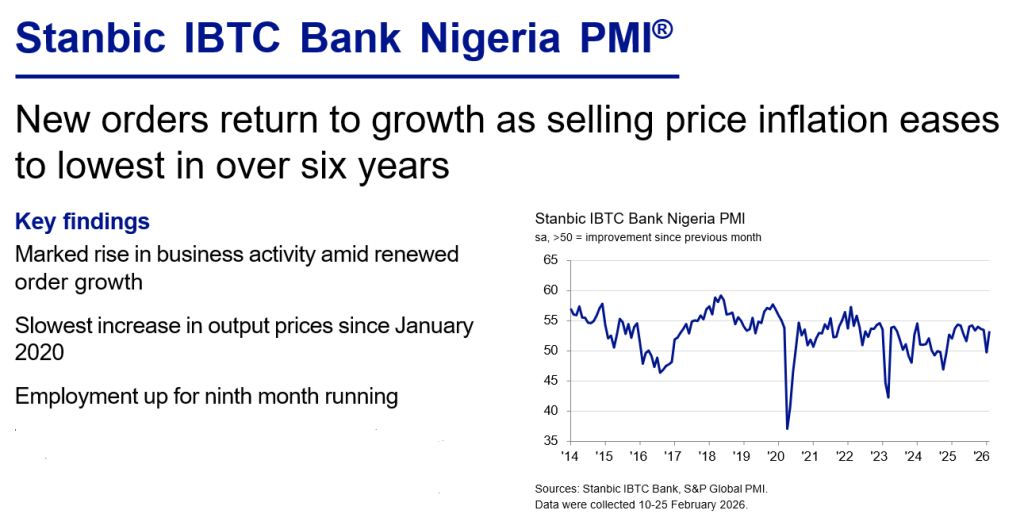
The Nigerian private sector returned to growth in February, following a muted start to 2026. A renewed rise in new orders fed through to an accelerated increase in business activity. Employment, input buying and inventories were also up midway through the opening quarter of the year.
Meanwhile, an improvement in the strength of the currency helped lead to an easing of inflationary pressures, with both purchase costs and output prices rising at the slowest rates in just over six years.
The headline figure derived from the survey is the Purchasing Managers’ Index™ (PMI®). Readings above 50.0 signal an improvement in business conditions on the previous month, while readings below 50.0 show a deterioration.
After dipping below the 50.0 no-change mark in January, the headline PMI recovered from the reading of 49.7 to 53.2 in February. As such, the latest data pointed to a solid monthly improvement in the health of the private sector. Except for January’s blip, business conditions have improved continuously since December 2024.
New orders returned to growth in February, with anecdotal evidence pointing to improving customer demand and better product affordability.
The rise in new business, higher customer numbers and new product offerings helped lead to a rejuvenation in growth of output, which increased markedly and at the fastest pace in four months. All four monitored sectors saw activity rise as wholesale & retail posted a renewed expansion.
Higher new orders led firms to expand their staffing levels again, and at the fastest pace since last October. Employment has now increased in nine consecutive months.
Despite sustained job creation, however, backlogs of work increased at the fastest pace since May 2020. Panellists linked rising outstanding business to delayed client payments, shortages of staff and materials, and power supply issues.
A desire to keep up with order requirements meant that companies expanded their purchasing activity and inventory holdings markedly in February. Suppliers’ delivery times continued to shorten, however, amid prompt payments and improved traffic conditions.
A stronger currency led to a marked easing in the pace of purchase cost inflation in February. The latest rise in purchase prices was the weakest in just over six years. Where inflation was recorded, panellists linked this to higher prices for animal feed and raw materials. Meanwhile, cost-of- living payments to workers meant that staff costs continued to rise.
With the rate of purchase cost inflation softening, firms also raised their output prices at a much weaker pace. Here too, the rate of inflation was the weakest since January 2020.
Advertising efforts and business expansion plans were central to positive expectations for output over the next 12 months. Sentiment picked up in February, but remained relatively muted.