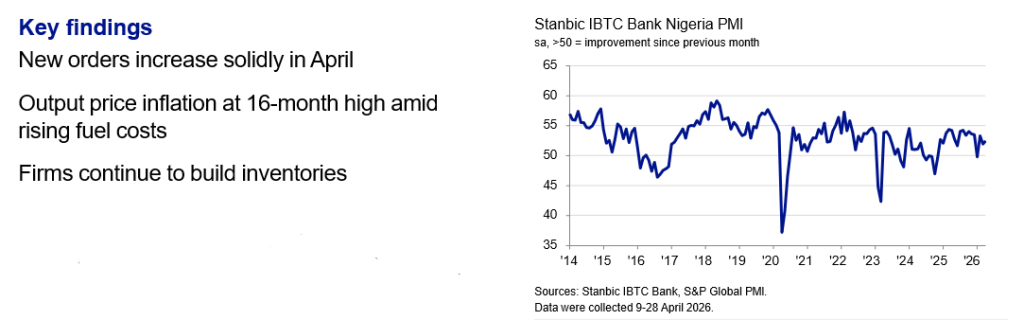
The Nigerian private sector remained in growth territory at the start of the second quarter of the year as customer numbers and market demand continued to strengthen. That said, the impacts of higher fuel costs as a result of the war in the Middle East were felt again, pushing up prices and reportedly limiting expansions in new orders and business activity.
The headline figure derived from the survey is the Purchasing Managers’ Index™ (PMI®). Readings above 50.0 signal an improvement in business conditions on the previous month, while readings below 50.0 show a deterioration.
The headline PMI ticked up to 52.4 in April from 51.9 in March, above the 50.0 no-change mark for the third month running and signalling a solid strengthening in the health of the private sector. The rate of improvement was slightly greater than that seen in the previous survey period.
Improving demand conditions meant that new orders continued to rise, albeit with the rate of growth softening amid inflationary pressures.
Business activity also increased, and at a solid pace that was slightly faster than that seen in March. Here too, however, companies mentioned that rising prices had limited the pace of growth.
Activity rose in three of the four monitored sectors, the exception being services.
Anecdotal evidence suggested that prices were often driven higher by increased fuel costs due to the war in the Middle East. Purchase prices increased rapidly, with the rate of inflation little-changed from March’s 15-month high. Meanwhile, staff costs rose modestly as companies in some cases increased pay to help workers deal with higher transportation fares.
The pass through of increased input costs to customers resulted in a further sharp rise in output prices, with the rate of inflation quickening to the fastest since December 2024.
Companies took on extra staff in April in response to rising workloads, but the rate of job creation was only marginal and the softest in three months.
Some firms reported that staff shortages had been behind the latest accumulation of backlogs of work, while others cited customer payment delays and issues securing raw materials. Outstanding business increased for the third consecutive month in April.
Further efforts were made to secure materials, with purchasing activity increasing for the seventeenth month running in April. Stocks of purchases also rose amid improving customer demand, and at a marked pace that was the sharpest in five months.
Where companies placed orders for materials, they often made sure to pay on time in order to secure deliveries. As a result, supplier lead times shortened again, albeit to the least extent in 2026 so far.
Business sentiment ticked higher in April, with companies often citing plans to expand operations. Half of all respondents predicted that their output will increase over the next 12 months.