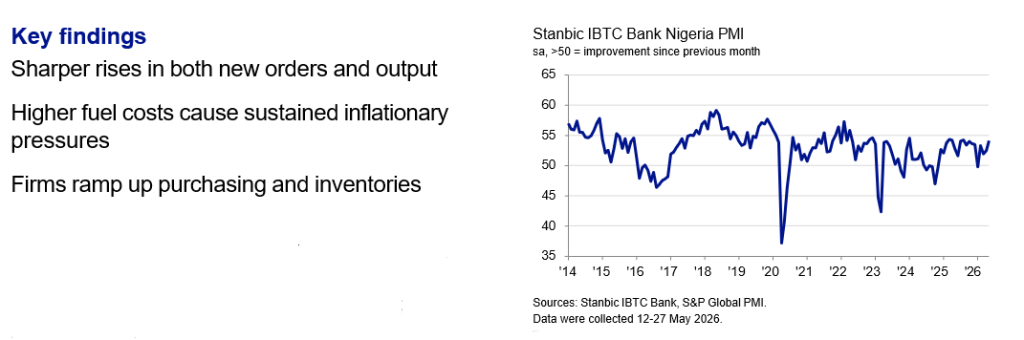
Growth momentum strengthened in the Nigerian private sector during May. Marked rises in output and new orders were recorded, with firms ramping up their purchasing accordingly. Expansions in employment remained muted, however. On the price front, higher fuel costs continued to cause sharp increases in input costs and output prices, but rates of inflation softened from April.
The headline figure derived from the survey is the Purchasing Managers’ Index™ (PMI®). Readings above 50.0 signal an improvement in business conditions on the previous month, while readings below 50.0 show a deterioration.
The headline PMI rose to 54.1 in May from 52.4 in April, signalling a solid monthly improvement in business conditions and one that was the most pronounced since August 2025. The health of the private sector has now strengthened in four consecutive months.
Central to the solid improvement in business conditions were marked and accelerated expansions in both output and new orders during May. Rates of growth hit seven- and nine-month highs respectively. Anecdotal evidence pointed to improving customer demand and the launch of new products.
Output growth was recorded across all four broad sectors covered by the survey.
Improving demand, and the prospect of further growth in the months ahead, led companies to expand their purchasing activity and inventories in May. Here too, rates of expansion quickened from April and were sharp.
Efforts to secure inputs were helped by an improvement in vendor performance, as prompt payments, goods arrangements with suppliers and better road conditions helped to speed up deliveries.
Employment continued to rise only slightly midway through the second quarter, although sustained job creation has now been recorded in each month for a year.
Meanwhile, backlogs of work increased for the fourth successive month amid customer payment delays, material shortages and power failures.
Increasing fuel costs following the outbreak of war in the Middle East continued to drive up purchase prices in May. Purchase costs rose rapidly again, despite the rate of inflation easing to a three-month low.
Purchase prices increased at a much quicker pace than staff costs, which rose modestly again in May. Where companies increased staff pay, this was often to provide help with higher living costs, and those for transportation in particular.
In line with the picture for input costs, output prices continued to rise sharply in May. Here too, however, the rate of inflation eased to the lowest since February.
Plans to increase advertising and expand operations through the opening of new branches and introduction of new products were behind optimism in the year-ahead outlook for output. Sentiment dipped, however, and was the lowest for a year.