Growth was maintained in the Nigerian private sector during July as firms again signalled a marked increase in new orders during the month. In turn, output and employment also rose, albeit modestly. Meanwhile, inflationary pressures softened.
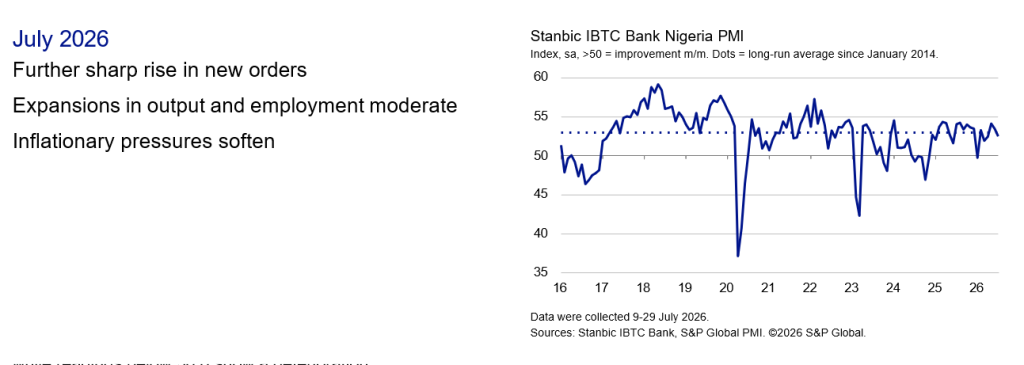
The headline figure derived from the survey is the Purchasing Managers’ Index™ (PMI®). Readings above 50.0 signal an improvement in business conditions on the previous month, while readings below 50.0 show a deterioration.
The headline PMI registered 52.5 in July, down from 53.4 in June but still above the 50.0 no-change mark and signalling a sixth successive monthly strengthening in the health of the private sector. The latest improvement in business conditions was solid, albeit the least pronounced in three months.
Companies signalled a further marked increase in new business in July, extending the current sequence of growth to six months. According to respondents, the launch of new products and competitive pricing had helped them to secure new orders, while general improvements in customer demand were also mentioned.
Improving demand conditions supported a further increase in business activity, albeit one that was only modest and the slowest since January. The agriculture and manufacturing sectors posted sharp rises in output, with growth more modest in the services and wholesale & retail categories.
A modest increase in employment was also recorded in July as companies responded to higher output requirements. Here, the pace of growth eased to a three-month low.
As well as raising staffing levels, purchasing activity was also expanded as firms made efforts to keep on top of workloads. Planning for future output requirements was also a factor behind a further marked increase in input buying, with inventories up accordingly.
Despite efforts to expand capacity and keep on top of workloads, logistical issues in some cases prevented projects being completed on time and backlogs of work rose slightly again in July. Supplier performance did improve at the start of the third quarter, however, following a first lengthening of lead times in a year in the previous survey period.
Inflationary pressures softened in July, with both input costs and output prices rising at weaker rates than in June. Purchase cost inflation slowed particularly sharply, easing to the lowest in five months. Purchase prices continued to rise at a marked pace, however, due to higher costs for fuel and raw materials. Meanwhile, staff costs increased modestly, and at the softest rate since April.
In line with the picture for purchase prices, Nigerian companies increased their own charges at the weakest pace since February. The agriculture sector posted the fastest rise in selling prices in July, with the slowest pace of inflation in services.
Companies remained optimistic that output will rise over the coming year, with just under half of respondents expressing a positive outlook. Confidence reflected enhanced marketing strategies and planned business expansions such as the opening of new branches. Sentiment dipped from June’s one-year high, however.