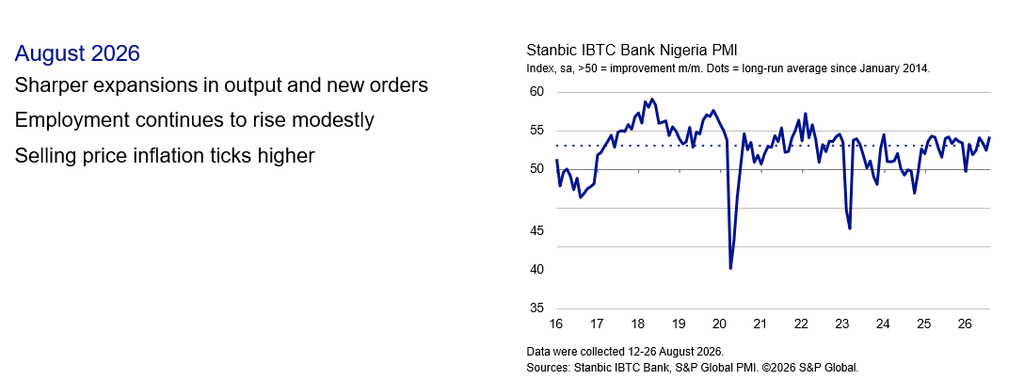
Nigerian companies increased business activity at a much faster pace in August amid greater success in securing new orders. In turn, purchasing and employment also rose, although the pace of job creation was only muted. Meanwhile, inflationary pressures ticked higher.
The headline figure derived from the survey is the Purchasing Managers’ Index™ (PMI®). Readings above 50.0 signal an improvement in business conditions on the previous month, while readings below 50.0 show a deterioration.
The headline PMI rose to 54.3 in August, up from 52.5 in July and signalling a solid monthly strengthening in the health of the Nigerian private sector. Moreover, the latest improvement was the joint-largest in just over two-and-a-half years, equal with that seen in March 2025. Business conditions have now strengthened in seven successive months.
New orders rose substantially midway through the third quarter of the year, and at a pace unsurpassed since the start of 2024. Panellists reported that customer demand had improved, while the launch of new products had also contributed to growth.
In response to sharply rising new orders, companies ramped up their business activity in August, with the rate of expansion much faster than seen in July. Some panellists also linked growth to better material availability. Output has now risen in each of the past 21 months. Underlying data pointed to increases in activity across all four broad sectors, with particularly strong growth in the agriculture and manufacturing industries.
Employment continued to rise, the fifteenth month running in which job creation has been recorded. That said, in contrast to the sharp expansions in output and new orders, the rate of jobs growth remained modest. Wholesale & retail employment even decreased, while rising staffing levels were registered elsewhere.
Despite the muted pace of job creation, companies were better able to keep on top of workloads in August, recording a fall in backlogs of work for the first time in seven months.
Improving customer demand and preparation for upcoming projects led companies in Nigeria to expand their purchasing activity in August, and at a strong pace that was the fastest since last November. In turn, the rate of inventory building also hit a nine-month high.
Suppliers’ delivery times shortened for the second month running, and to a greater extent than in July. Prompt payments and good relationships with suppliers were among the factors helping to speed up deliveries, according to respondents, with competition among vendors and improved logistics also behind shorter lead times.
The rate of purchase cost inflation ticked up in August but was still below the average over the year-to-date. Higher fuel and transportation costs were widely reported, with companies also indicating that raw material prices had risen during the month.
Meanwhile, the rate of staff cost inflation eased to the weakest in nine months.
In line with the picture for purchase costs, the pace of output price inflation quickened in August as companies passed higher expenses on to customers. Agriculture recorded the fastest increase in charges of the four monitored sectors. Looking to the future, companies remained optimistic that output will rise over the coming year, although sentiment dipped to a three-month low. Anecdotal evidence suggested that positive sentiment reflected a range of factors, including plans to expand into new locations, export to other economies and raise employment. Expected improvements in customer numbers also supported optimism.