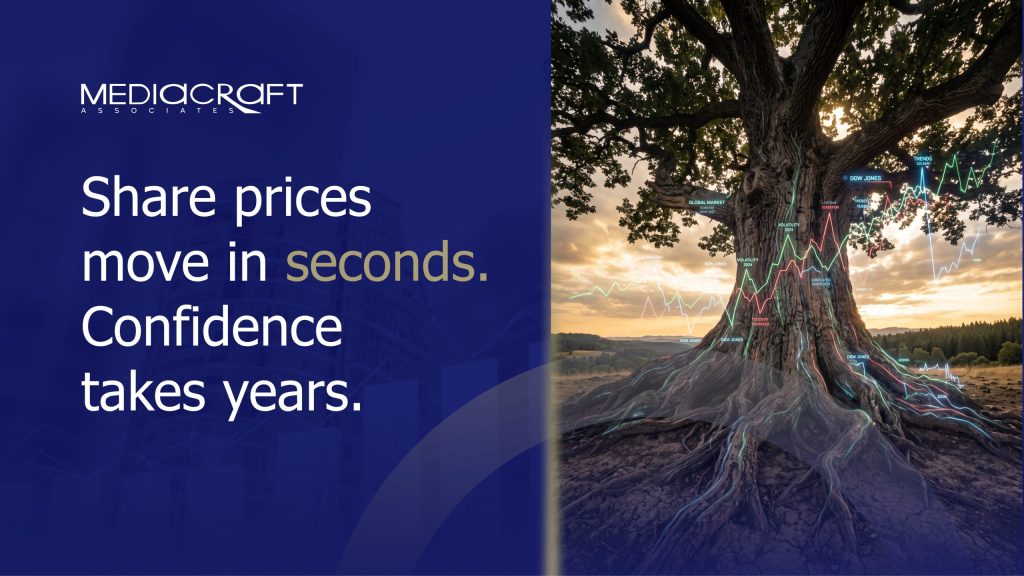
One of the most important lessons for any first-time investor is also one of the least glamorous: wealth creation rarely happens overnight. It is a truth that resists retelling because it makes for a poor story. The narratives that travel fastest are the dramatic ones — the overnight fortune, the stock that tripled in a week, the person who “got in early” and walked away rich. These stories are memorable precisely because they are rare. And in mistaking the exception for the rule, many new investors set off chasing something that almost never happens, and overlook the thing that almost always does.
The dramatic, get-rich-quick price spike makes for good entertainment, but it is almost never how durable wealth is actually built. Understanding why is one of the most valuable shifts a new investor can make — and it opens the door to a second, quieter lesson about how returns actually reach the people who own shares.
The First Lesson: Value Is Built, Not Bolted On
Lasting value is created through years of disciplined execution by well-managed businesses. It is the accumulation of thousands of ordinary decisions made well: serving customers, controlling costs, reinvesting profits sensibly, expanding into the right markets, weathering downturns without losing the plot. None of these individually make headlines. Together, over time, they build something formidable.
Market capitalisation — the total value the market places on a company — is simply the cumulative reflection of those years of work. It is a scoreboard, not an engine. When you look at a large, valuable company today, you are not looking at a single brilliant moment. You are looking at the compounded result of consistent value creation, quarter after quarter, often across decades.
This is why the world’s largest companies are rarely the ones that had a single extraordinary year. They are usually the ones that created value consistently over a very long time. The occasional explosive year certainly happens, but it tends to be the by-product of durable strength rather than its source. A business does not become great because of one spectacular quarter; it has spectacular quarters because it has quietly become great.
For a first-time investor, this reframing matters enormously. It moves the central question away from “What is about to spike?” — a question almost nobody answers reliably — and toward “Which businesses are being run well enough to keep creating value for years?” That is a far more answerable question, and a far more useful one.
The Second Lesson: How Returns Actually Reach You
Hidden inside the first lesson is a second one, and it concerns the mechanics of how a shareholder is actually rewarded. Well-run companies often reward their owners in two ways at once, and understanding both changes how patience feels.
The first way is capital appreciation. As a business grows and investor confidence in it builds, the value of its shares can rise over time. If you own a share of a company that is steadily becoming more valuable, the market’s assessment of your share tends to rise with it. This is the source of return most new investors already have in mind — buy at one price, and over time the share may be worth more.
The second way is dividends. Many established, profitable companies pay out a portion of their earnings directly to shareholders, frequently on a recurring basis. This is real income, arriving while you continue to hold the share. You are not required to sell anything to receive it. It is a share of the profit the business generated, paid to you simply because you are an owner.
This dual source of returns — a growing share value alongside regular dividend payments — is one of the defining characteristics of sustainable long-term wealth creation. It means a patient shareholder can benefit from two things at the same time: from what a company is becoming, and from what it is earning along the way. The investor who understands only appreciation sees half the picture. The one who understands both sees why holding a quality business over time can be quietly, steadily rewarding even in years when the share price does little.
Why the Two Lessons Belong Together
Put the two lessons side by side and a clear picture emerges. The investors who build real wealth are usually not the ones who timed a lucky spike. They are the ones who owned quality businesses patiently and allowed both appreciation and dividends to compound over time.
Compounding is the mechanism that ties everything together. When dividends are reinvested, they buy more shares, which then earn their own dividends and participate in further appreciation. Value builds on value. The early years can feel underwhelming precisely because compounding is back-loaded — the most dramatic effects appear late, only for those who stayed. This is why patience is not a passive virtue in investing. It is the active ingredient. The person who sells early to chase the next exciting story steps out of the very process that would have rewarded them.
It also reframes what “slow” really means. Slow is not the opposite of powerful. In investing, slow is frequently exactly where the power comes from. The unhurried accumulation of value, the reinvested dividend, the business quietly compounding — these are not consolation prizes for people who missed the excitement. They are the main event, visible only to those willing to measure their progress in years rather than days.
What This Means for a First-Time Investor
The practical implication is not that excitement is bad or that fast movements never happen. It is that a strategy built on catching them is a strategy built on luck, and luck is not a plan. A more durable approach starts from a different set of habits: choosing well-managed businesses, understanding that value is created gradually, appreciating that returns can arrive through both a rising share price and recurring dividends, and then giving that combination the one thing it genuinely needs — time.
None of this requires predicting the future. It requires understanding the process well enough to trust it, and the temperament to stay invested while it works. That temperament is rarer than it sounds, because the loud stories never stop arriving. But the investor who can hold quality patiently, and let appreciation and dividends do their compounding work, is playing a game with far better odds than the one forever hunting the next spike.
Slow is not the opposite of powerful. In investing, slow is often exactly where the power comes from.